

"We've seen this movie before in the 2009-2012 period, first in Greece and then in Portugal, Spain, and Italy," wrote Krugman
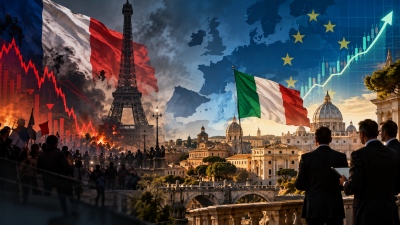
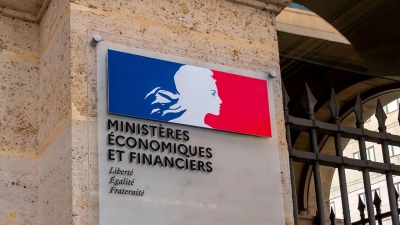
Europe is entering a new period of fiscal uncertainty, with France at the epicenter of fears regarding a new sovereign debt crisis. Nobel laureate economist Paul Krugman is sounding the alarm, warning that Eurozone's second-largest economy may have become "too big to bail" by the European Central Bank (ECB). Rising public debt servicing burdens, elevated deficits, and the political difficulty of enforcing fiscal adjustment measures heighten anxiety, awakening memories of the Eurozone debt crisis during the 2009–2012 period.
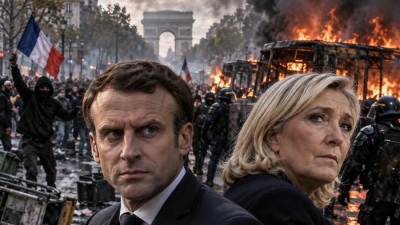
France in turmoil
Student mobilizations over education underfunding continue to cause unrest across France, while Prime Minister Sébastien Lecornu struggles to secure approval for a controversial 2027 budget predicting fiscal adjustment measures worth tens of billions of dollars. In a post on his Substack blog, Krugman argued that France is following a "fiscally unsustainable path," burdened by mounting interest payments on its national debt while massive fiscal deficits exacerbate an already elevated debt-to-GDP ratio. A primary problem, he argued, is the country's inability to address its relatively low retirement age while its population ages. "France's reliance on the euro means it is very easy to imagine how this loss of confidence could turn into an ugly crisis. We've seen this movie before in the 2009-2012 period, first in Greece and then in Portugal, Spain, and Italy," wrote Krugman, referencing the sovereign debt crisis that triggered extensive ECB interventions. "First, investors stop buying a Eurozone country's bonds, creating the risk that the government will be forced into default simply because it lacks the funds to pay interest and redeem principal on its debt. The fear of default then drives even greater capital flight, which intensifies default fears and raises interest rates. Thus, the vicious cycle deepens."
Bailout of France too costly
The famous assurance by then-ECB President Mario Draghi in 2012 that the Bank would do "whatever it takes" to prevent sovereign defaults was widely accepted, largely because Southern European nations executed "massive spending cuts," noted Krugman. A bailout of France would prove "extremely costly" for the ECB and provoke political battles as long as the country moves "even further from fiscal responsibility," he continued. "France may have crossed the line from 'too big to fail' to 'too big to bail.' In short, it is very easy to describe a genuinely nightmarish scenario for a French crisis that would deeply divide Europe," he wrote.
French government must "present something credible"
Speaking to CNBC on Friday, former ECB chief Jean-Claude Trichet called on politicians to reach a compromise in order to reduce the deficit of the European Union's second-largest economy. Trichet, who led the ECB from 2004 to 2011, stated: "Responsibility now rests with the French government and parliament, which have a lot of difficult work ahead." "Of course, if destabilization occurs, there are many tools available that have proven highly effective in the past. And naturally, I experienced such a period during my own tenure," the former Bank of France governor told CNBC. These mechanisms include the European Stability Mechanism (ESM) and, in the most extreme scenario, the ECB's Transmission Protection Instrument (TPI). This measure, finalized in 2022, remains unused to date and aims to ensure market stability during periods of Eurozone fragmentation. For intervention to occur, the French government would need to formally approach the ECB and request assistance, a step Trichet currently considers unnecessary. "My recommendation to all political forces in France, and you know the situation is complicated ahead of political preparations for the presidential elections, is for everyone to demonstrate responsibility under these circumstances." "All political forces, regardless of their stances, must understand that the time has come to prove that France, as a market participant, is responsible." "I call on them, naturally, to conduct their debates as efficiently as possible and prove they can arrive at a credible solution. This, of course, constitutes one of the prerequisites for activating the TPI," he stated. Trichet noted that his own experience from the sovereign debt crisis demonstrated that "you must first help yourself, because we cannot succeed unless you personally convince market participants, investors, and savers that you are reliable." "Naturally, you must also convince the country itself that it is moving in the right direction. That goes without saying. That, if I understand correctly, is also the conviction of the governor of the Bank of France and the French government," he added.
www.bankingnews.gr






Σχόλια αναγνωστών